



In questo nuovo articolo presentiamo le riflessioni di alcuni frati carmelitani scalzi, che espongono la loro visione per rinnovare il marianismo carmelitano nelle sue diverse dimensioni: carismatica, mariologica, pastorale e devozionale.
Devotion to Our Lady of Mount Carmel and the local Marian Devotion
I would like to share some of my thoughts on the Carmelite devotion to the Virgin Mother of Carmel and Marian veneration at the Carmelite monastery in Vienna, Austria, with gratitude for the invitation to write on the topic.
Marian devotion helps people to grow in their faith, drawing them closer to Christ and deepening their sense of belonging to the Church. The Second Vatican Council states that Mary’s maternal solicitude reaches out to all. The Council affirms that in the plan of God, it is always Mary who leads us to Christ (Cf. LG 60-65). The devotion to the Virgin Mary presents her as the first disciple, the first listener to the Word and the companion of the pilgrim Church. Her active Role at the Shrines makes them the privileged sites for evangelisation and renewal of the Marian devotion. They are sites for healing, reconciliation and spiritual reorientation. As Pope Francis emphasises the evangelising power of popular devotion, shrines reflect the faith of the people and offer opportunities for grace and growth (Cf. EG 122–126). Each shrine offers a unique expression of faith within its cultural and geographical context, bringing forth spiritual and practical benefits, and thus, any Marian shrine can serve as a sacred symbol of God’s active presence among His people.
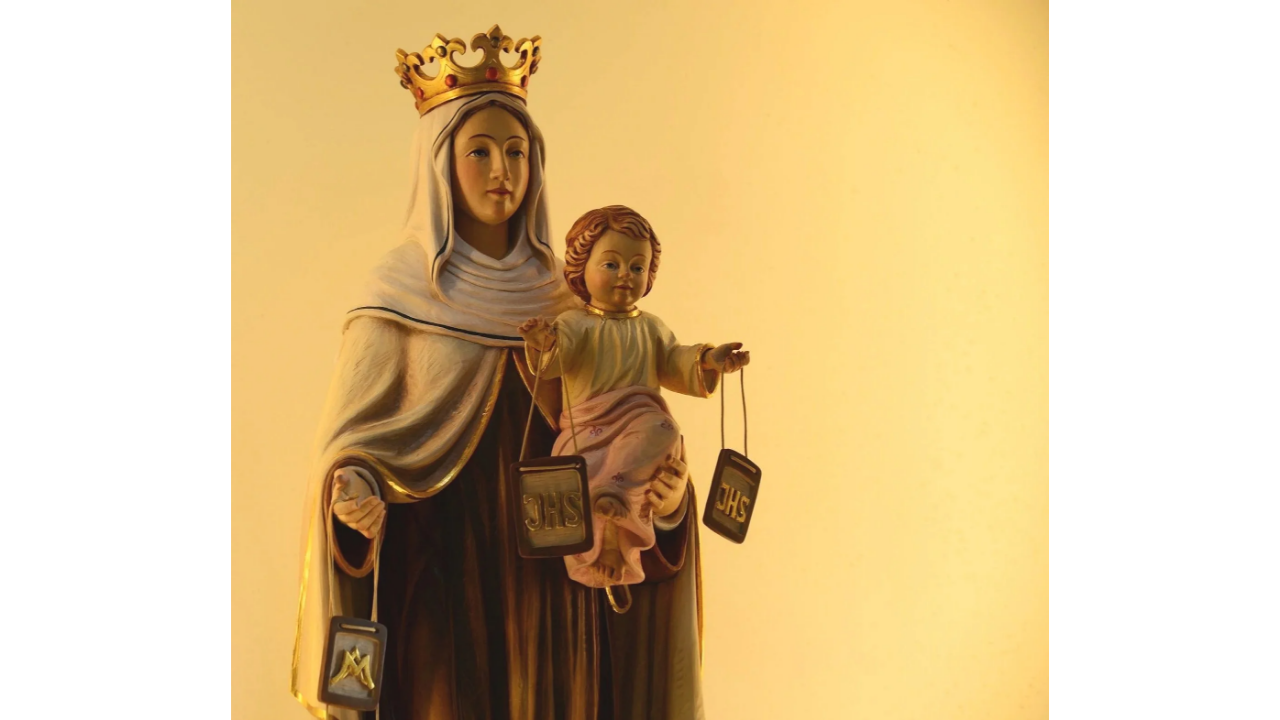
What sets devotion to the Mother of Mount Carmel apart within the broader Marian context is its strong foundation in Carmelite spirituality. Rooted in the medieval hermits of Mount Carmel, this devotion highlights contemplative prayer and an inward journey toward God. The Carmelite tradition views the Virgin Mary not only as Mother but also as a spiritual companion who leads the faithful to contemplative life. The Brown Scapular plays a central role in this effort. The Carmelite Order and the Directory on Popular Piety clarify that the scapular symbolises covenant and discipleship. It represents a connection to a spiritual tradition committed to “meditate on the Law of the Lord, day and night”. Deepening devotion to the Mother of Mount Carmel requires, thus, renewing the understanding of the scapular, highlighting it as a lifelong commitment to live the Gospel rather than just a protective ornamental accessory.
Connecting Scapular devotion with Christian maturity entails practical actions such as participating in the Eucharist, daily prayer and works of mercy inspired by Mary’s Hymn, Magnificat. This approach encourages a Marian discipleship characterised by humility, reflection of the Word of God and a sense of mission. To energise and deepen this devotion, Carmelites can lead theological conferences and formation programs, retreats on Carmelite spirituality, accessible catechetical resources and communal scapular enrolment rites. These initiatives should emphasise Carmelite themes such as silence, interiority and prophetic engagement with the world. Simultaneously, they should be receptive to local cultural expressions, acknowledging what John Paul II and the International Pontifical Marian Academy often point out, that popular piety is a legitimate theological space and a meaningful route to holiness when appropriately embraced and guided.
It is worth experiencing that the enduring solidarity and maternal care of the Virgin Mary, powerfully depicted over 400 years in the tradition of Our Lady with Bowed Head,[1] are celebrated and venerated in the Carmelite Monastery church in Vienna, Austria. Especially during the two World Wars, pilgrimages to “our Mother of Döbling” were very popular, and to this day, an organised pilgrimage Mass and devotional activities take place here on the second Wednesday of every month. Added, the Carmelite Monastery in Vienna promotes Marian veneration and spirituality through its various active spiritual engagements for the local faithful, importantly through the solemn celebration of the feast of Our Lady of Carmel and the promotion of scapular devotion.
However, it is my growing concern that we need to discuss openly and further in our Order to develop a Marian spirituality that should be widely recognised and practised among us, as a remedy to the kind of Minimalism that is permeated among us. An increased attentiveness to her contemplativeness and an active involvement in academic discussions would be effective for the creation of space for ecumenical dialogues and, thus, an active engagement in the theological and practical ecclesial life.
In short, devotion to Our Lady of Mount Carmel continues to be a powerful tool for spiritual growth when presented in a biblically sound, theologically consistent and pastorally engaging way. Our Marian shrines can serve as spaces where the faithful reconnect with the contemplative spirit of Carmel and are nurtured in Christian maturity under the loving guidance of the Mother of God. By blending Carmelite traditions and modern pastoral strategies, we can renew and deepen our Marian tradition for the church today.
[1] The Marian image, “Our Lady of the Bowed Head”, had settled in the Carmelite Church in Vienna (Austria); with the address: Katholische Kirche Karmelitenkirche (Hl. Familie), Silbergasse 35, 1190 Wien, Austria. Cf. https://www.facebook.com/groups/290889978523696/posts/1082022859410400/
Karmelitenkonvent Graz - Maria Schnee OCD
Grabenstraße 144, A-8010 Graz
To all rectors, superiors or directors of MARIAN SHRINES linked to the Discalced Carmel and the Virgin of Mount Carmel
Our opinion and our suggestions on following questions:
1. How can we evangelize and give deep meaning to Marian devotion?
Marian devotion must always lead to Christ. Mary is not an aim in herself, but the one who says, “Do whatever he tells you.” That is why it is important to connect devotion with the Gospel, the sacraments, prayer, and a practical life of faith. In Carmelite spirituality, Mary is primarily a model of listening to the Word of God, of silence, faithfulness and interior life.
2. What actions/initiatives of Marian devotion are you promoting around the shrine?
At our Carmelite monastery in Graz, we place special emphasis on the celebration of Our Lady of Mount Carmel, the Scapular devotion, Marian prayers, and pilgrimages. Catechesis on Carmelite spirituality, prayer of the Rosary together in a community, Eucharistic adoration, and the connection between Mary and the concrete concerns of people’s lives are of great importance. We try to ensure that devotion does not remain merely a custom, but leads to a deeper relationship with God.
3. What is specific about devotion to the Virgen del Carmen? Or is it something like the other Marian devotions?
The devotion to Our Lady of Mount Carmel has a strongly contemplative dimension. We see Mary as a mother and sister on the journey of faith, but also as a model for the interior life and complete openness to God. What is unique about the Carmelite tradition is its connection to the prophet Elijah, prayer, silence, and life in the presence of God. The Scapular is a sign of belonging to the Virgin Mary, but even more so a call to live the Gospel.
4. How to deepen devotion to the Virgen del Carmen and how to energize it?
It is necessary to move from a purely external devotion to a personal spiritual relationship with Mary. This means more catechesis, biblical and theological interpretation,
and a connection with prayer and the sacramental life. People today are seeking authenticity—which is why the witness of one’s life often evangelizes more than words alone.
5. How can we deepen the experience of the scapular and put it in relation to Christian maturity?
The Scapular should not be understood as a “talisman,” but as a sign of our relationship with Christ and our calling to follow him and imitate him together with Mary. It serves as a reminder of our baptism, our belonging to Christ, and our call to holiness. Christian maturity means living responsibly, in prayer, and faithfully—and this is precisely what the Scapular is meant to inspire.
6. What suggestions do you think are appropriate to enrich this devotion?
It is important to offer high-quality spiritual formation: catechesis, spiritual renewal, Lectio Divina, testimonies, and prayer meetings. It is also good to connect Marian devotion more closely with the Eucharist, the Word of God, and practical acts of charity. Young people, in particular, are seeking an experience of community, silence, and authentic spirituality.
7. What do Marian shrines contribute to our spirituality?
Marian shrines become places of conversion, peace, and encounter with God. Oftentimes, people who are wounded, feeling exhausted and tired, or searching for meaning come to these places. At these shrines, Mary helps people rediscover God’s closeness and the simplicity of faith. From a Carmelite perspective, a shrine is also a place of silence, prayer, and inner renewal of the heart.
Best regards and best wishes from the Carmelites in Graz!
fr. Vedran Pavlić OCD and the other Carmelites in Graz